


Article: Mirror Work Outfits for Sangeet and Mehendi: A Styling Guide You Cannot Miss

Mirror Work Outfits for Sangeet and Mehendi: A Styling Guide You Cannot Miss
There is an embroidery tradition in India that understands something about celebration that most other decorative techniques miss. Mirror work doesn't just sit on fabric and look beautiful under normal light. It responds to the room around it. The soft lighting at a mehendi, the fairy lights strung across a rooftop, the spot lighting at a sangeet. Every source of light becomes a collaborator with mirror work outfits and adds to the festivities. The outfit is never quite the same twice.
This is why mirror work has always been the instinctive choice for the two functions in an Indian wedding that carry the most joy and the most energy. The mehendi and the sangeet are not formal occasions. They are celebrations - of craft, of community, of the specific happiness that fills a room when people who love each other are dressed beautifully and given permission to dance. Mirror work was made for exactly this.
A Brief History of the Mesmerizing Craft of Mirror Works
Mirror work, also known as shisha embroidery or abhla bharat, originated in the artisan communities of Kutch, Gujarat, and parts of Rajasthan.
The word shisha means glass or mirror in Persian. The technique involves securing small pieces of reflective material to fabric using embroidery stitches that lock each piece in place while leaving most of its surface exposed to reflect light.
Historically, mica was used for this craft, which has now been replaced by glass mirrors.
What distinguishes genuine handcrafted mirror work from machine-made approximations is the edges.
Each mirror in a handcrafted piece is individually wrapped in thread with a specific stitch. The stitching creates the characteristic surround that holds the mirror and defines its shape.
Machine-made mirror work stamps or glues the mirrors in place. Under any kind of focused light, the difference is immediately visible.

Shop Now: Maheen Purple Mirror Work Mul Chanderi Handcrafted Kaftan Set
Why Mirror Work Belongs at Mehendi and Sangeet
The mehendi is the pre-wedding function where color and texture do the most work. It is typically held outdoors or in bright natural light, across several hours of sitting, talking, eating, and being photographed with arms extended while the henna artist works.
That is why a mehendi outfit needs to be comfortable, visually distinct, and beautiful without being so formally embellished that it feels wrong on a relaxed afternoon.
Mirror work on Silk Chanderi is the most precise answer to this brief.
The fabric breathes, drapes easily, and doesn't trap heat the way heavier silks do. The mirror embroidery provides the visual weight and occasion-presence that mehendi dressing calls for without adding physical weight.
And crucially, mirror work photographs exceptionally well in natural light. The mirrors create small points of brilliance across the fabric that read as genuinely festive in daytime photography.
The sangeet is a different brief. It is an evening function, typically indoor, with controlled and often warm lighting, dancing, and the kind of social energy that rewards outfits with movement and response.
Under a sangeet's spotlights and fairy light settings, mirror work doesn't just reflect light - it distributes it.
A kurta set or choga set with dense mirror work becomes, in a room with active lighting, one of the most alive things in the space.
It moves differently in light than it does in shadow. It creates an effect that sequins and zardozi don't replicate, because mirror work is reflective rather than refractive - it sends light outward rather than absorbing it. 
Shop Now: Nira Orange Mirror Work Silk Chanderi Handcrafted Kurta Set
The Dohr Mirror Work Collection - Silhouette for your Mehendi and Sangeet Nights
When it comes to mirror-work outfit ideas for Sangeet and Mehendi, Dohr’s collection is the answer. From mirror-work kurta sets to Kaftan sets, you are sure to dazzle at these functions just like the mirror work itself!
The Mirror Work Kurta Set, The Versatile Foundation
Mirror work kurta sets crafted on Silk Chanderi not only look grand but also offer a luminosity of their own that complements mirror embroidery without competing with it.
The mirrors sit on a surface that is already slightly lustrous, which means the embroidery and the fabric work together rather than the embroidery having to do all the visual work alone.
The Nira range - in ruby pink, olive green, and orange - and the Avin range - in blue, olive green, and ruby pink — are the collection's most directly occasion-appropriate kurta sets.
Both feature mirror work placed with the kind of confidence that comes from understanding where the reflective surface will read most powerfully - at the neckline, down the placket, across the sleeves, along the hemline. Not scattered. Placed.
For the green edit, choose Lehar - available in olive green, emerald green, and yellow - which brings the same quality to a slightly different silhouette.
The emerald green and yellow are particularly strong mehendi choices - both colors have the warmth that natural light rewards, and both work with the traditional colour associations of the function.
The Veera and Veya ranges extend the palette further - the Veera in baby pink, emerald green, and ivory; the Veya in blue, orange, and ruby pink. The Veya in orange with mirror work is one of those combinations that photographs beautifully at both mehendi and sangeet, the warm tone working equally well in afternoon sun and evening lamp light.
|
Shop Now: Nira Olive Green Mirror Work Silk Chanderi Kurta Set |
|
|
|
Shop Now: Veera Emerald Green Mirror Work Silk Chanderi Kurta Set |


Mirror Work Choga Set For the Woman Who Wants to Be Remembered
The choga is the sangeet silhouette that most women reach for when they want more than a kurta set. It provides the layered structure and the additional surface area for embroidery.
Dohr's Mirae range in Silk Chanderi - in yellow, ivory, and royal blue - carries mirror work across the choga and the matching set beneath it in a way that creates a complete look from every angle. The yellow Mirae under sangeet lighting is extraordinary. The royal blue Mirae is for the evening function and has a slightly more formal social dimension.
|
Shop Now: Mirae Royal Blue Mirror Work Silk Chanderi Handcrafted Choga Set |
Shop Now: Mirae Ivory Mirror Work Silk Chanderi Handcrafted Choga Set |


Mirror Work Kaftan Set - The Mehendi Piece That Stays Comfortable All Day
The Ruvina and Zeva kaftans occupy a specific and undervalued category in mehendi dressing.
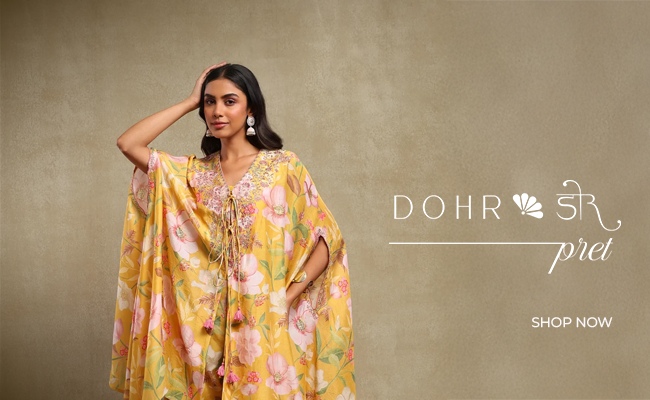
The kaftan silhouette is the most comfortable form of occasion wear that exists. It requires no fitting in the way a kurta does, moves completely freely, and in Mul Chanderi feels almost like wearing nothing while looking like a considered choice.
The mirror work on the Maheen, Ruvina, and Zeva kaftans is placed at the neckline, cuffs, and hem - which is the traditional placement that maximises visual impact while keeping the central body of the fabric lighter and more breathable. For a mehendi function that runs from afternoon through early evening, this is the intelligently built option.
The Zeva in navy blue - worn by both Sanah Kapoor and Kamya Gupta - and in olive green demonstrates how the kaftan format carries mirror work with a relaxed authority that more structured silhouettes can't quite replicate. The navy blue kaftan at a mehendi, with mehndi-covered hands and gold jewellery, is one of the most complete looks in the Dohr collection.
|
Shop Now: Zeva Navy Blue Mirror Work Mul Chanderi Handcrafted Kaftan |
Shop Now: Ruvina Purple Mirror Work Mul Chanderi Handcrafted Kaftan |


The Mirror Work A-Line Kurta Set - For the Woman Who Wants Structure and Movement
The Zora range brings the A-line silhouette to mirror work in Silk Chanderi. The A-line flares gently from the waist, creating movement at the hem that a straight kurta doesn't, making it particularly effective at sangeet, where that movement adds to the evening's dancing energy.
The Zora Yellow was worn by Shiveeka Nirula and the Zora Baby Pink by Supriya Nagpal - both demonstrating how the A-line silhouette distributes mirror work across a surface that moves, which is where the embroidery is most dynamic.
|
Shop Now: Shiveeka Nirula In Zora Yellow Mirror Work Silk Chanderi Handcrafted A-Line Kurta Set |
Shop Now: Zora Royal Blue Mirror Work Silk Chanderi Handcrafted A-Line Kurta Set |


The Honest Bottom Line
Mirror work is not a trend that arrived in Indian fashion recently and will depart when the next season begins. It is a craft tradition with five centuries of practice behind it, carried by artisan communities whose knowledge of the stitch and the placement and the reflective quality of the glass is not teachable in a workshop. Dohr's mirror work collection draws from this tradition - not as a reference or an aesthetic gesture, but as a genuine craft commitment. The mirrors are individually secured. The Silk Chanderi and Mul Chanderi are chosen for what they do alongside the embroidery, not despite it.
At a mehendi, a sangeet, or any celebration that rewards an ethnic outfit that responds to the room around it — mirror work is the intelligent choice. And in Dohr's collection, it is the handcrafted choice, which in 2026 is the most significant distinction any embroidery can carry.